Una página para reforzar el aprendizaje del idioma inglés de forma lúdica y divertida, repasando
Mostrando entradas con la etiqueta socials. Mostrar todas las entradas

lunes, 8 de noviembre de 2021

THE AGES OF HISTORY


Prehistory began with the appearance of human beings and is the longest period in the past. It is divided into three periods: Palaeolithic, Neolithic and Metal Age.

The first humans were nomadic, and they hunted, fished and gathered plants to survive.

Over the years they discovered agriculture and animal husbandry became sedentary and built houses and villages to live in.

They began to make tools from stones and animal bones.

They also created pottery and learned to work metals.


The Ancient Age began about 5000 years ago, when writing was invented.
The first civilizations emerged: Egyptians, Greeks, and Romans.
The Romans conquered the Iberian Peninsula between the 3rd and 1st centuries BC, 
and called it Hispania.

The Romans organized Hispania into provinces. They imposed their customs,
 Roman laws, and the use of Latin, founded cities, and introduced Christianity.


The Middle Ages began with the end of the Roman Empire, in AD 476. C.
The Visigoths, one of the Germanic peoples from northern Europe, invaded Hispania and 
founded a kingdom on the Peninsula.
In the year 711 the Muslims conquered the Visigothic kingdom and created al-Andalus. 
The Christian kingdoms organized to expel them and expand their borders. 
This period was called La Reconquista. 
This period of the Middle Ages ended when the Catholic Monarchs conquered the kingdom of Granada.
During this stage the cities grew and castles and monasteries were built. 
Two artistic styles stood out: Romanesque and Gothic.


The Modern Age began in 1492 with the discovery of America. This period saw important discoveries and inventions,

such as the printing press.


In the 16th and 17th centuries, Spain was ruled by the Habsburg dynasty. The first kings, Charles I and Philip II,

created a great empire, which weakened in the 17th century.

In the 18th century a new dynasty, THE BORBONS, began to reign.

During this period two artistic styles developed: RENAISSANCE and BAROQUE.

In Spain it was called the GOLDEN CENTURY because of its cultural and artistic splendor.

In the 18th century, the ideas of the Enlightenment arrived in Spain.


lunes, 21 de junio de 2021

SPECTACULAR ASTRONOMICAL PHENOMENA OF THE SUMMER


The June solstice is the astronomical phenomenon that marks the arrival of summer in the northern hemisphere and the beginning of winter in the southern hemisphere. This year, it will occur on Sunday, 20 June at 22:32.

This will be the longest day of the year in the northern hemisphere, with 13 hours and 25 minutes of sunlight, a pattern that will diminish as the year progresses, until it reaches its antithesis, the shortest day on the winter solstice.

Summer will also mark the farewell of the biggest and brightest moons of the year.

The last supermoon of 2021 will take place on 24 June.


The Perseids are one of the most eagerly awaited astronomical phenomena of every summer in the northern hemisphere. This shower of stars originates from comet Swift-Tuttle, a distant visitor to Earth that completes an orbit around the Sun every 133 years.

When the debris of dust, ice and cosmic rocks that it left behind during its last passage hurtles towards our planet, it causes meteors to streak across the celestial vault in a matter of tenths of a second.

Also known as the Tears of St. Lawrence, the Perseids are the third most intense meteor shower of the year.


The gas giant of the Solar System will reach its closest point to Earth and the best time to observe it on 19 August, just two weeks after Saturn's opposition.

Jupiter will appear brighter than normal once night falls in the east.


sábado, 29 de febrero de 2020

THE EARTH GUIDE PROJECT


This is our home Planet.
Do we really know it?
What shape is the Earth?    It's almost completely round.
What is the Sun? It's a star. It's in the center of our Solar System. It give us light and heat.
The sun isn't a planet. It formed 5 billion years ago from a cloud of gas and dust.
The sun's diameter is 1.392.000 kilometres. It is much bigger than the Earth.
What is the Moon? It's a natural satellite of the Earth. It orbits around the center.
Super Moon 2020, on Monday March 9.


It's called Super Worm Moon. 

How far is the Earth from the Sun? It's about 150 million kilometres.
What layers does the Earth have? The Earth have four layers: Crust , Mantle, Outer Core and Inner Core


Why is the Earth called the 'BLUE PLANET'? Because This planet has got a lot of water. It looks like blue from space.
 What causes the seasons? It is the movement of revolution..


What are Natural Satellites? They are smaller celestial bodies. They revolve around planets.
What are the phases of the Moon? Full Moon, First quarter Moon, New Moon and Last quarter Moon.
What is the Earth's axis of rotation ? It's an imaginary line . This line goes from the North Pole to the South Pole. This axis isn't  perfectly vertical. It has got inclination of about 23 degrees.


Some planets are near the sun like... Venus, Mars, Mercury and  The Earth.
Venus is the second planet from the sun. It is the brightest and hottest planet. This planet can be see from the Earth.
Some planets are far away from the sun. These planes are Jupiter, Saturn, Uranus and Neptune.
Saturn is the sixth planet from the sun. It is the second biggest planet. Saturn has got rings made of ice and rock. Saturn has got lots of moons.


WATER CYCLE


"HAPPY EARTH DAY- 22nd April, 2020"
We can recycle materials like:

  • Plastics
  • Cardboard paper
  • Glass
This will reduce the amount of trash in our landfills.
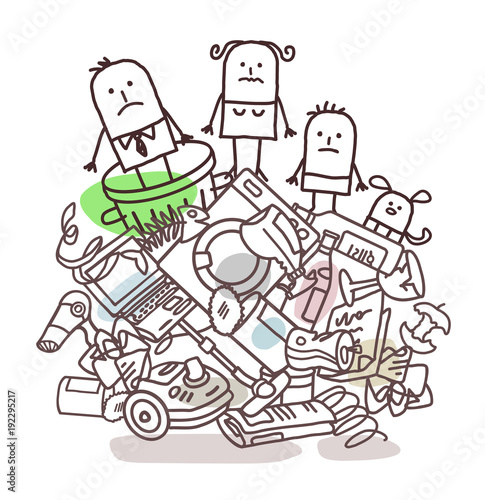
Cartoon Family on a pile of Garbage - Buy this stock vector and ...

Earth Day comes once a year. But we should make our message clear...

LOVE AND CLEAN OUR EARTH 
             EACH          DAY


lunes, 4 de diciembre de 2017

WHAT IS THE SPANISH CONSTITUTION?

It was approved on 6th December, 1978.
The rights and freedoms of citizens and equality before the law are guaranteed.


Institutions of the Spanish State:
 ------------The King is the head of state.
-------------The Cortes Generales exert legislative power.
-------------The government  exerts executive power.
-------------The judges and the courts of law exert judicial power.


Autonomous Regions
------------------------What is the right to autonomy ? It  is the power to make certain governmental decisions at regional level.
Spain has got seventeen autonomous  regions an two autonomous cities. These cities are  Ceuta and Melilla.
Each region has got its Statute of Autonomy.